
MINORITEN
KIRCHE
SOUNDING
About the gradual fabrication of the buildings while listening IV
Location
Minoritenkirche Krems, AT
Work
sound installation
and
Live soundintervention
Year
2005
Equipment
6 speakers,
2 subwoofers
3 playback devices
Organizer
Donau Festival
Execution
Josef Reiter
The installation focuses on the intense experience of the intrinsic sound of the Minoritenkirche space.
An exploration of the sound character of the room, its distinctiveness, perceptible in the room's own resonances, the characteristic accentuations and attenuations in the frequency spectrum due to the proportions of the room and the characteristics of the hall, is in the foreground, the concrete room is analyzed as a resonating body and made to sound.
minoritenkirche sounding continues explorations of the relationships between sound, space and
architecture from earlier works. However, the focus is more on the examination of
„symbolic space", as well as architectural-mathematical relations, e.g. the proportions of space
proportions, the main focus shifts to the exploration of the physical - acoustic space, the "real space“. An acoustic analysis, the acoustic fingerprint of the Minoritenkirche thus becomes the basis and starting point of minoritenkirche sounding. In the work in the studio and directly on site, electronic sound material is combined with recorded samples of acoustic instruments, in this case of double bass and a bassclarinet and contrabass clarinet. With an exact positioning of the loudspeakers the room is brought to sound in a slow process, in the sounding out of the border areas of the resonances to sound.
A walkable constantly changing, never repeating sound continuum is created, . . .
Sounds that penetrate everything in a given space, and at the same time reflect the space that contains them.

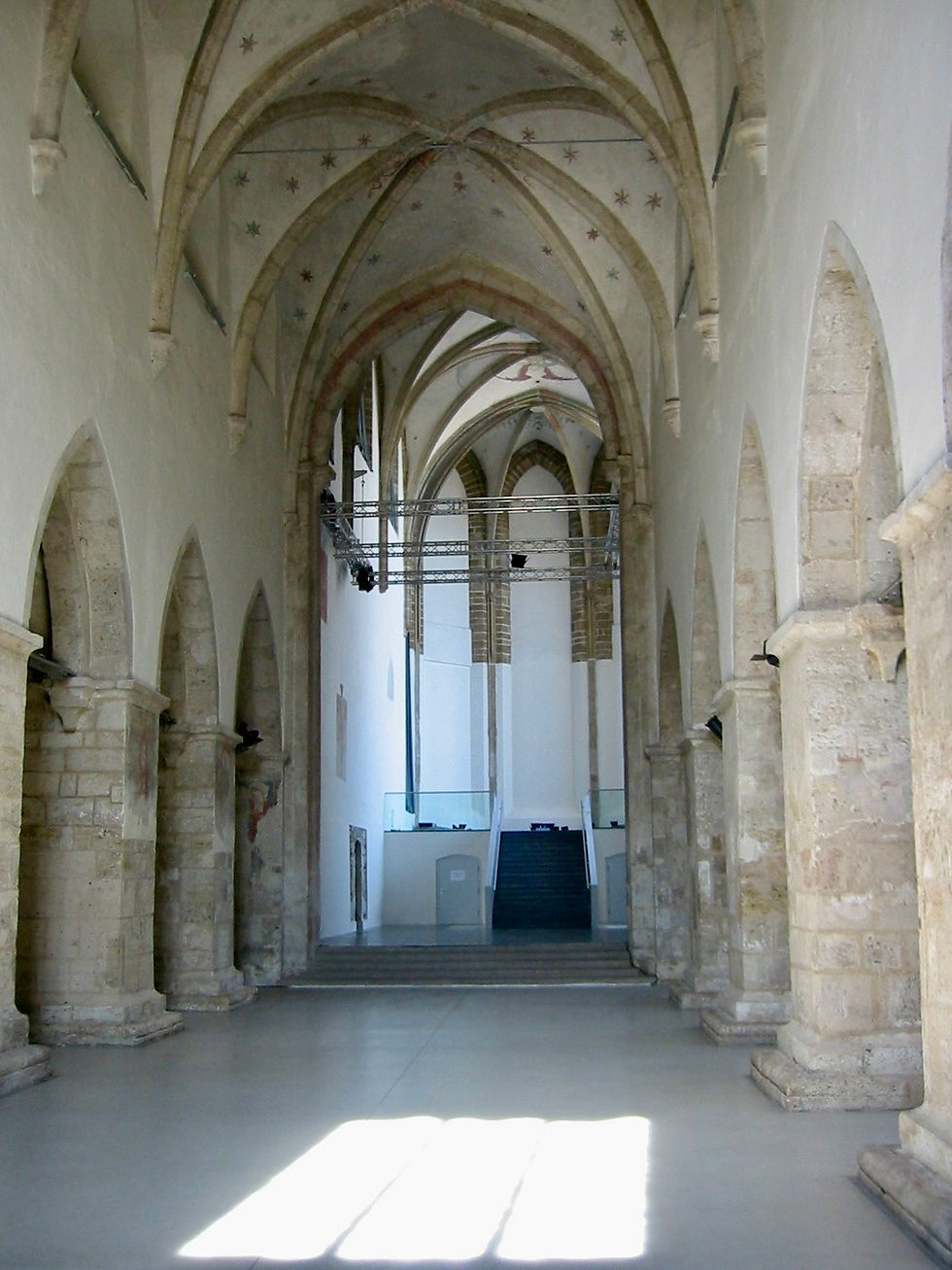

live sound intervention
Minoritenkirche Sounding
In the Minoritenkirche Krems as part of the 2005 Donau Festival
The musicians work with the sound stock gained from the acoustic analysis of the room, the sound material of the sound installation as well as various given
articulation guidelines in the first part of the piece.
At the beginning, the two instruments are alone and unamplified. From minute three the clarinet and the double bass, picked up by five microphones, are amplified and mixed and are projected into the room. In the further course of the piece the live played sound material
is subjected to subtle spectral or vocoder-like transformations. From minute fourteen
(part two) the constantly changing sound installation is added as a "feed" via six loudspeakers
distributed in the room. The musicians react to this installation sounding as "room sound", they are -in- the installation, i.e. they take up this material in certain phases or step -out- of the installation, play against it or take up material of the fellow musicians. The interventions in the slowly changing sound continuum range from subtle supporting sounds to more violent outbursts. The audience can follow the thirty-four minute performance sitting in the middle, enveloped by the sounds, or moving around the room, taking over the sound direction for themselves, so to speak. At the end, the musicians disappear into the continuing sound installation.


Donna Wagner-Molinari,
Bass and double bass clarinet
Ernst Weissensteiner, double bass
Josef Reiter, electronic devices